Steven Arciniega
Content Strategist—Office of Strategic Marketing and Communications



Jun 8, 2026
“I chose to study at Redlands because of the social justice impact. The program directly teaches you how to be successful in these environments.”
Growing up, teachers often referred to Chris Herrera ’21 as gifted. Skipping kindergarten and holding the highest test scores through elementary school, it was natural that the adults in his life expected more from him. That changed in the summer between seventh and eighth grade when Herrera was met with the unexpected passing of his father.
“I lost all interest in school, ultimately dropped out of high school, and fell through the cracks,” he said.
Angry at feeling abandoned by the education system, Herrera eventually bounced back, completing his Master of Arts in Learning and Teaching at University of Redlands School of Education.
Today, he teaches AP Precalculus at Rialto High School, observing students like him — gifted.
“I tell my students, ‘You’ll never guess what class I failed,’ and I tell them how I failed math in eighth grade because I didn’t care anymore,” he said. “I could complain about the problems in secondary education or jump in the trenches and do something about it.”
Growing up in the Inland Empire, Herrera understands the environment his students live and learn in. After completing high school, he earned an associate’s degree from San Bernardino Valley College while serving as a husband and new father. Earning a Bachelor of Science in Math from University of California, Riverside, Herrera set his sights on teaching math at the college level and enrolled in California State University, Long Beach’s (CSULB) graduate program. While becoming a parent for the second time, he calculated what his future could look like.
“I thought about my family stability — if I’m an adjunct professor, I’m not going to have health insurance, I’d have to drive to various colleges to teach one or two classes, and I’d be gone in the evenings,” he said. “Nothing we've done has been easy, but we always figured out a way.”
The way forward meant dropping out of CSULB and moving back to the IE. This didn’t signal failure — it brought Herrera to the doorstep of U of R and the MALT program.
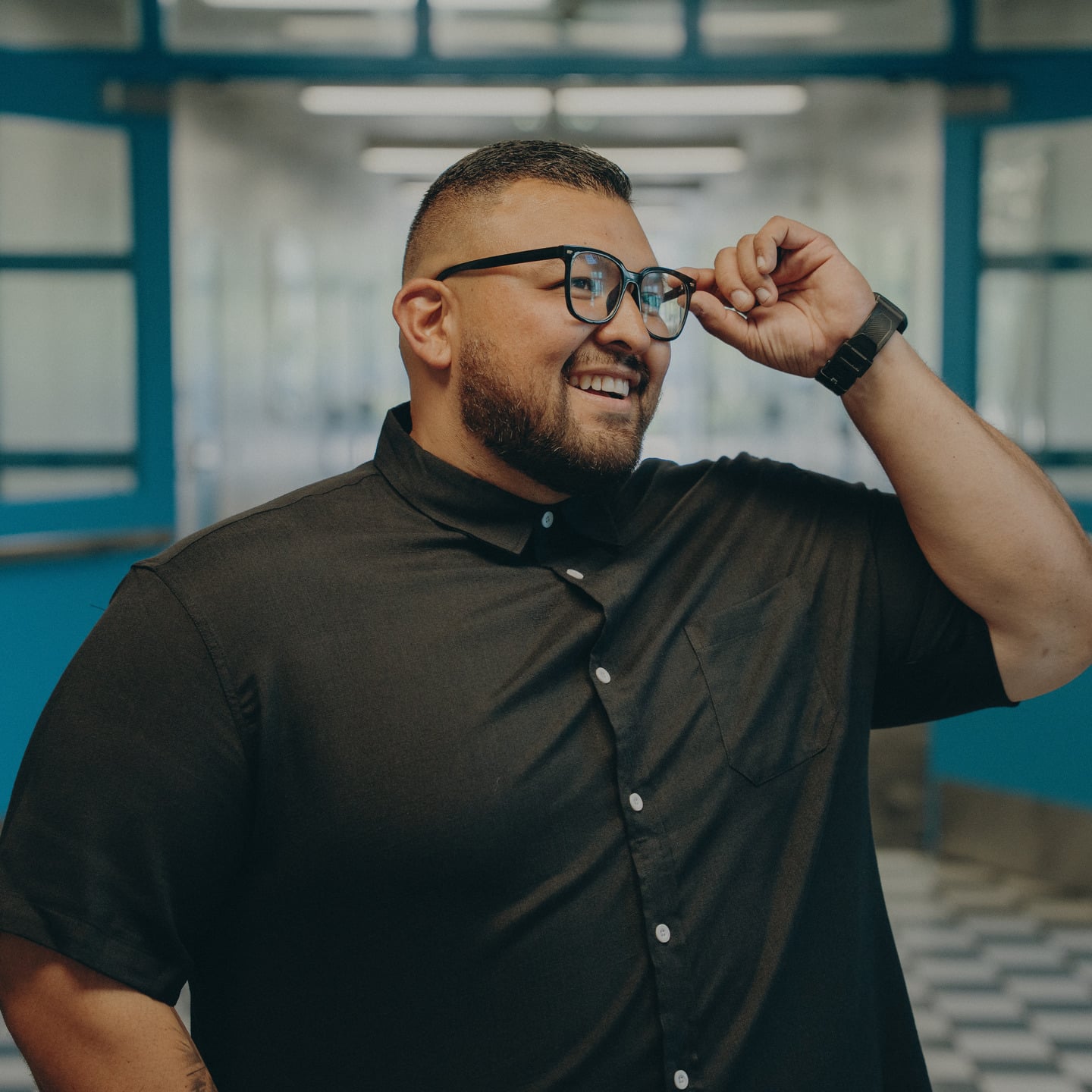
The MALT program offered something rare: a credential and a master's degree simultaneously, a practical path that respected the realities of Herrera and his family’s lives, and a way for its students to look beyond pedagogy. Teaching and learning assistant professor Mousumi De challenged Herrera and his cohort to examine their assumptions and step outside their own upbringing — to see the communities they'd be serving with clear, honest eyes.
“I chose to study at Redlands because of the social justice impact,” he said. “The program taught us to approach our environment informed, knowing how to solve problems that these kids are facing — from social, emotional, economic, and academic deficiencies, it gives us the lens to immediately implement solutions. The program directly teaches you how to be successful in these environments.”
In addition to being prepared, Herrera brought something that the curriculum couldn’t teach: the experience of being a kid that the system overlooked. When one of his students lost his father, Herrera empathized with him.
“I have such a soft spot for that kid and for all my kids,” he said.
Surprising him the most during the program was an exercise where Herrera and his cohort had to draw something that inspired them to continue and push them through the program.
“When my wife and I had our photoshoot for our undergraduate graduation, we had our son in a cap and gown and included him in the photos,” he said. “I drew a version of that to show him that it’s possible and to make sure he follows the same path.”