
Steven Arciniega
Content Strategist—Office of Strategic Marketing and Communications


Nov 5, 2026
“They should get the marketplace of ideas, and they should figure out what works for them by the time they leave, and have the skills to figure that out."
What did a University of Redlands psychology professor have in common with some of the nation's most distinguished scholars from Yale, Harvard, Princeton, and Columbia?
Catherine Salmon was about to find out. An unexpected email from the president of the American Academy of Sciences and Letters (AASL) invited her to join its highly selective ranks.
She immediately accepted. Only after reviewing the membership roster did the magnitude of the honor begin to sink in.
“There’s no one from a school this small,” she said.
Until now. Nominated by a peer, Salmon was selected for the Academy’s 2026 incoming class and will be recognized on November 4 at the Library of Congress, in Washington, D.C. Her admission into the Academy, an organization dedicated to honoring excellence in scholarship across the disciplines of the modern university and upholding the value of intellectual courage and open inquiry to the university’s mission, is a direct result of Salmon’s research and teaching prowess, grounded in her tenure at University of Redlands.
Salmon isn’t sure exactly why the Academy chose her. She suspects it was a combination of her role as a founder of the Society for Open Inquiry in the Behavioral Sciences, her work as co-editor on “The Free Inquiry Papers,” and her record as a scholar.
“I think it was the combination of that, maybe, and the academic record,” she said.
That record begins in undergraduate biology, where Salmon, trained as a biologist, found her way to graduate school in psychology. Her instinct to approach the study of human behavior as she once did animals remains — applying an evolutionary lens to everything from mating and sexuality to body image, arguing that understanding what has shaped behavior is key to any desired attempts to modify it.
Questions like these can draw criticism from every direction. Salmon asks them anyway. She brings the same approach into her classroom, where she teaches sexuality and psychology of the sex industry.
One of her students shared in an evaluation that nothing was off the table and no one’s views were judged — a response Salmon takes as a sign of trust in her classroom, and the point of a university.
“A concern people have raised about universities is that students only get presented with one view — it's the professor's view, and if you want a good grade, you're going to give the professor what they want to hear — that's not what it's supposed to be about,” she said. “If we can't teach students to think for themselves, and aren’t encouraging them to learn how to articulate their views with evidence, then what's the point?”
For Salmon, that emphasis on intellectual courage is the point of the Academy.
“It’s a way to acknowledge, reward, and highlight people who are willing to say things that are controversial, or may not fit the narrative,” she said. “The work in open inquiry is urgent, and people are still getting punished for it.”
In her classroom, students hear all sides of an argument. Her reading lists include competing perspectives, so students who disagree on whether prostitution should be legal have to engage with the strongest case on each side, akin to a debate class where a student is assigned a position. If a question ever feels too risky to ask aloud, students can email Salmon or leave a note in her mailbox.
“Either you know the answer, or you don’t. It’s not stupid to ask if you don’t know; how else are you supposed to learn,” she said.
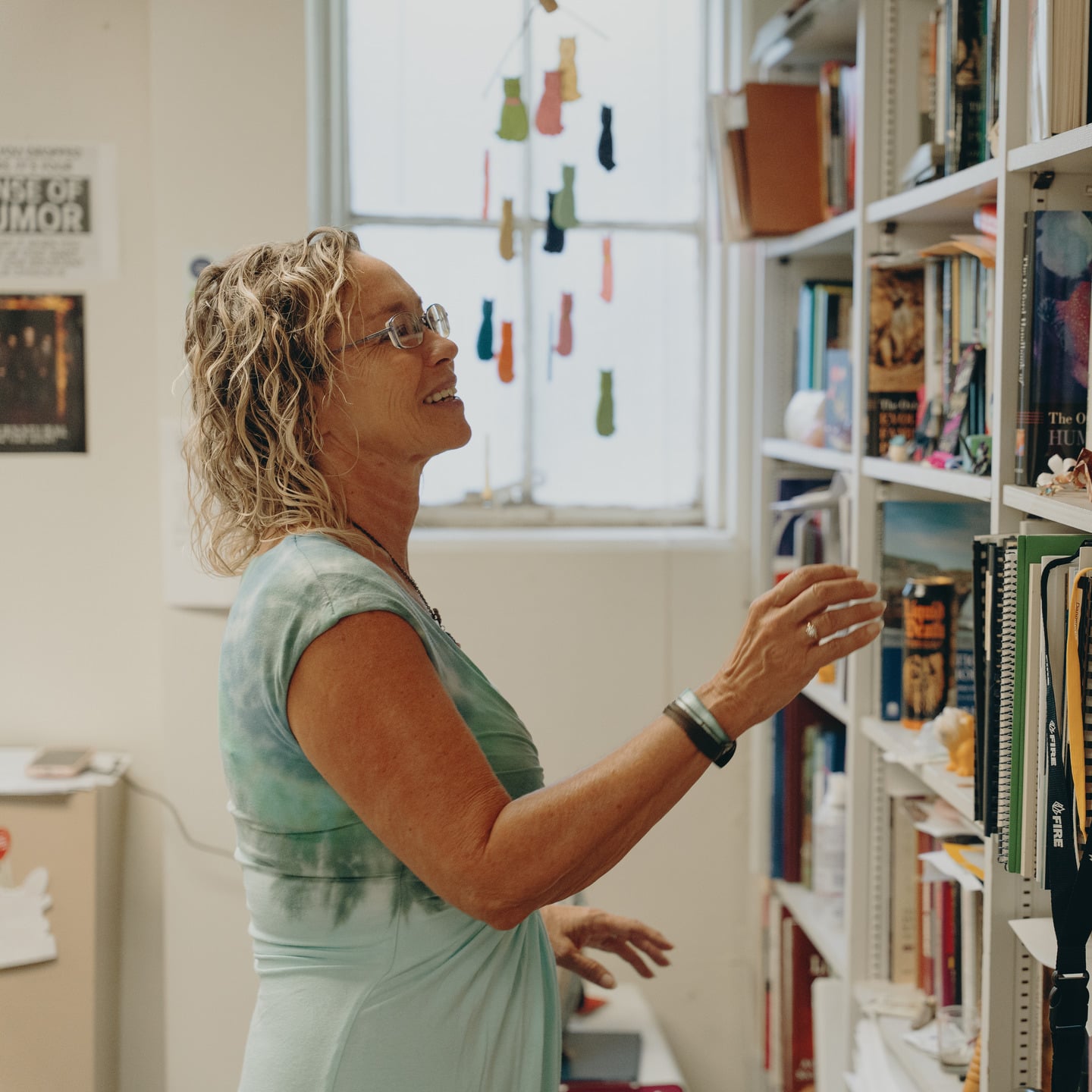
Salmon said Redlands’ small classes make those conversations easier, benefiting scholarship, and a pillar of the Academy’s values.
“Students are going to be interacting with professors and with other students, and so I think it creates an atmosphere that is better for talking about those issues,” she said. Students still have to reach out, she added, but the opportunities are “much more easily accessible.”
What she hopes they take with them when they leave her classroom is the ability to think for themselves.
“They should get the marketplace of ideas, and they should figure out what works for them by the time they leave, and have the skills to figure that out,” she said.
That same freedom, to question and pursue answers, has shaped her own path. When she was hired, Salmon said she expected more freedom to study whatever she wanted.
“That has so far been true for me,” she said.