
Catherine Garcia '06



Dec 8, 2025
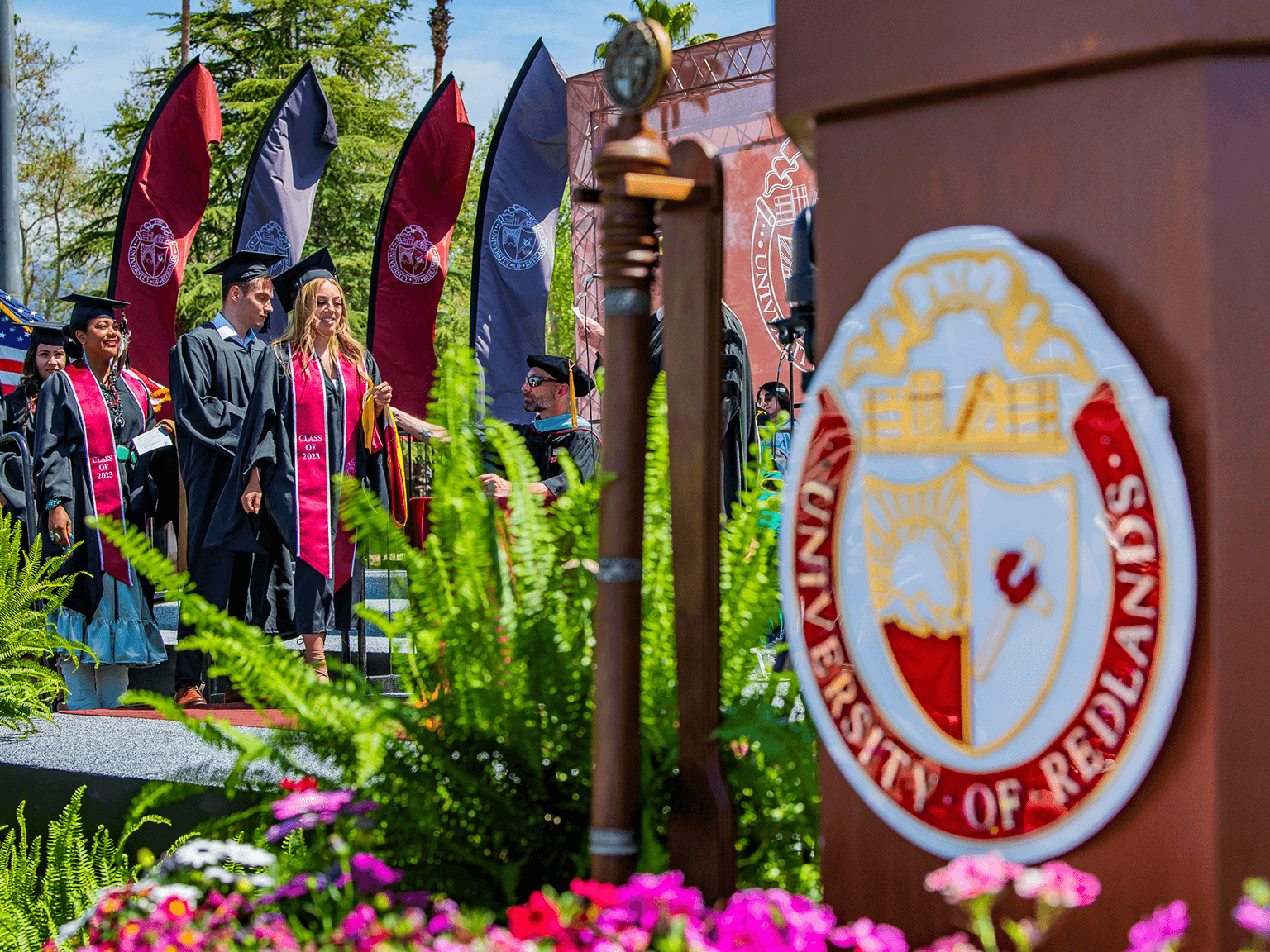
Anyone who has attended an event at University of Redlands in the last 28 years knows retired Chaplain John Walsh. He delivers the invocation at Commencement, provides narration at the Feast of Lights, welcomes students at Convocation, and offers comfort at candlelight vigils.
It’s not just Walsh’s face that is familiar. One day while shopping at a grocery store in Redlands, a woman came up to him and asked, “Are you the person who speaks at the Feast of Lights?” From an aisle away, she was able to recognize Walsh’s voice, a sound heard so clearly on campus for nearly three decades.
Walsh officially retired as chaplain on Dec. 31, 2020, but with a caveat. He still teaches one class on ethics every semester and participates in public events when asked. “I joked that all those years they paid me to do what I was loving to do—they didn’t understand I would have done it for nothing,” Walsh said.
Before coming to Redlands in 1998, Walsh served as a chaplain at UC Berkeley, Princeton, Harvard, and Middlebury College. While at Princeton, he was a mediator between Washington and Tehran during the 1979 Iran Hostage Crisis, meeting with Ayatollah Khomeini and the students who occupied the U.S. Embassy. This experience illustrated how a “university chaplain has an opportunity to use their voice for justice and peace, on a very local level and a very global level,” Walsh said.
A brief stint as a church pastor in North Carolina made Walsh realize “I needed tobe back on a college campus, where my gifts lie and where my heart is,” he said. While searching for chaplain positions, he found a job listing for Redlands.
Unfamiliar with the University, he visited the website, and while searching found a familiar name: Tracy Fitzsimmons, one of his favorite students from Princeton. She was teaching politics at Redlands, and when he called to ask her if the University would be a fit, Fitzsimmons was “ecstatic,” Walsh said. “She said it would be perfect.”
She encouraged Walsh to apply for the job and later advocated for his hiring. This was proof of something Walsh often tells students: “You tell us how we change your lives, but you don’t understand how often you change ours.”
His time at Redlands was fulfilling, as he provided chaplain services; taught courses and seminars like Religion and the Environment, the Search for Historical Jesus, and Human Rights and Foreign Policy; took students on May Term trips to Cuba, Salzburg, and Civil Rights sites in the South; and participated in campus life. He built strong friendships with colleagues and had a standing lunch date with several professors, including Jim Spee, Jim Spickard, Joseph Magedanz, and Monty Hempel.
“We had our table there in the Commons,” Walsh said. “We spent quality time together, solving all the problems of the world. It was a neat group.”
It was imperative to Walsh that he spend time not only in the Memorial Chapel as chaplain, but also in the classroom. This allowed him to teach students “important ideas and thoughts” while also connecting with professors, and although this amount of work took “a lot of effort,” he said, it was also “energizing to get up and go every day. You think, ‘What’s going to happen today? Who’s going to come into my once and change my life today? What experience am I going to have?’”
Walsh actively engaged with the Redlands community as well, building ecumenical relationships by inviting members of the Redlands Islamic Center to use the Chapel’s Prayer Room and welcoming Holy Name of Jesus parishioners for Easter services. He also served on the City of Redlands’ Human Relations Commission for 10 years, including three as chairman, and several oversight committees. He has long been involved in local environmental groups, and in 2007 went to Nashville for training on how to present Al Gore’s “An Inconvenient Truth.”
Today, he may technically be retired, but Walsh isn’t slowing down. Every Monday, he can be found at the Prayers for Peace gathering at the Labyrinth on campus, and on Tuesdays and Thursdays in his classroom teaching. “If I ever got up on a Thursday morning and looked at my notes and said, ‘I can’t do this anymore,’ I would quit that day. But I’m so far from that,” he said. “If this is what retirement looks like, I love it."